Why rural damage goes structural more often
Speed and geometry decide whether a crash stays cosmetic, and Uxbridge’s roads are unkind on both counts. A car that leaves a concession road does not slide into a curb — it drops into a ditch, and the ditch wall loads one corner of the structure with the vehicle’s full momentum. A deer strike at 80 km/h on Highway 47 crushes the rad support and can shove the upper rails out of dimension. Even the township’s culverts and laneway entrances play a part: a front wheel dropped hard off a washed-out gravel edge can tweak suspension mounting points without leaving much visible bodywork at all.
The tell-tale signs are worth knowing. Doors that suddenly need a slam. Panel gaps that pinch at one end. A steering wheel that sits off-centre after the car was recovered from the ditch, or new tire wear a month after the incident. Any of those after a hard hit means the structure needs to be measured — not eyeballed, measured — before anyone talks about paint.
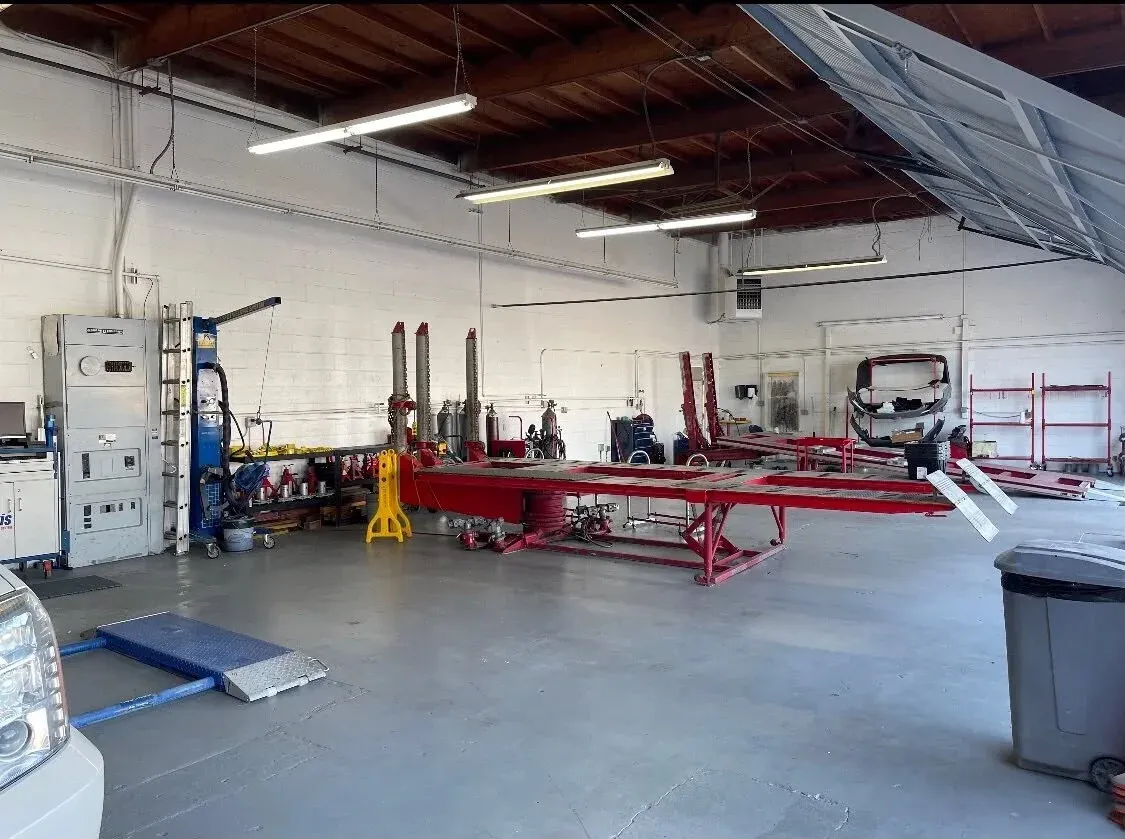
Measured, pulled, measured again
Structural repair here follows a documented loop. The vehicle goes on the bench, its control points are measured against the manufacturer’s specifications, and the printout shows exactly which dimensions have moved and by how much. The pull happens in controlled stages — anchored, corrected in millimetres, and re-measured — until the readings sit inside factory tolerance. Every measurement is kept in the file, because your insurance company deserves proof the correction happened and the next owner’s inspection deserves a paper trail.
Uxbridge’s vehicle mix means we work both architectures. Unibody cars and crossovers concentrate crash energy into engineered crumple zones, and correcting them is about restoring those zones without over-pulling work-hardened steel. Body-on-frame pickups — a large share of the township’s driveways — can hide a diamond or sway condition in the frame rails under a bed that still looks straight. Where a section is beyond safe correction, sectioning or replacement follows the manufacturer’s procedure, and we put the OEM parts case to the insurance company in writing.
- Factory-spec measurement printouts before and after correction
- Staged pulls on anchored equipment, never guesswork
- Unibody and body-on-frame experience, cars to pickups
- Suspension geometry checked and alignment verified before return
Total-loss talk, tow-ins, and the honest path
Structural claims are where repair cost and vehicle value collide. Ontario sets no fixed write-off percentage; the insurance company weighs the car’s actual cash value against repair cost plus salvage and decides case by case. Our job is to make that decision honest — a real teardown, a real measurement report, and a repair plan the adjuster can evaluate, rather than a shrug and a guess. When a car is genuinely not worth saving, we say so early, because a customer 55 km away should not burn weeks discovering the obvious.
Logistics are simple even when the damage is not. A car with suspected structural damage should ride a flatbed, and Ontario’s towing rules put the destination in your hands — name Collision Auto Center and we coordinate the pickup from the recovery yard, your laneway, or the roadside. The claim runs from our office with updates from the owner, and the finished car is inspected and road-tested before you make the trip down to collect it. (647) 594-3401, Monday to Saturday 8 AM to 7 PM, Sundays by appointment.