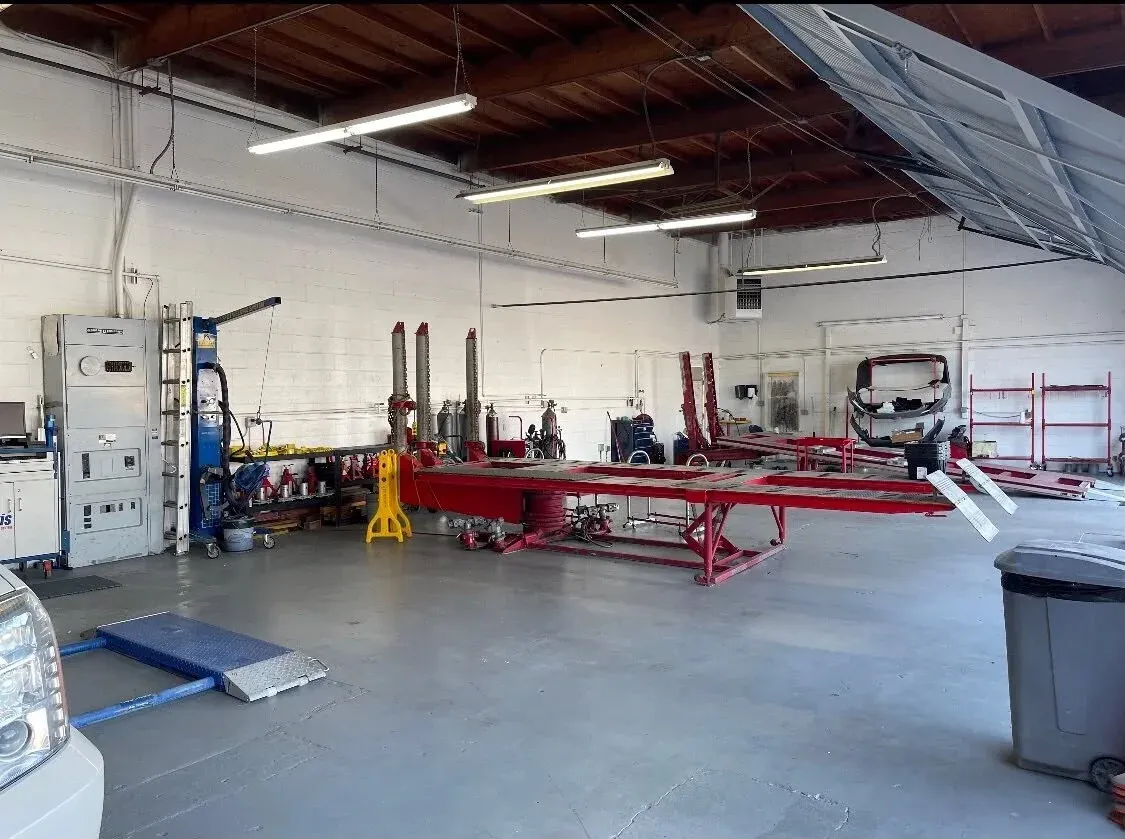
The hits that bend structure happen at Burlington’s speeds
Structural damage is mostly a highway product, and Burlington lives on highways. A rear-end in the QEW queue at 40 km/h can shorten a rear rail; a merge gone wrong where the 403 and 407 divide at Freeman can push a front rail and strut tower out of position in a single hit; a gust on the Skyway can put a car into the barrier hard enough to matter. The deceptive cases are slower: a front wheel dropped into a February pothole on Plains Road, or a snowbank curb strike at the mouth of a Millcroft crescent, can bend suspension mounting points while the body panels barely bruise.
What all of these share is invisibility. A car can look almost straight and be measurably wrong underneath — doors that need a lift to latch, a steering wheel that sits off-centre on New Street, tires that scrub on the way up Guelph Line. That is why the first stage of every structural file here is measurement, not opinion: the vehicle goes on the bench, dozens of reference points are compared against the manufacturer’s specifications, and the printout says how far out things are, in millimetres, before anyone talks about repairs.
Measured, pulled, re-measured — and documented for the claim
Straightening is controlled work. The vehicle is anchored, and hydraulic pulls bring the structure back in increments, with measurements taken between steps so nothing is dragged past specification. Modern unibodies complicate this in a useful way: many use high-strength and ultra-high-strength steels that the manufacturer says must be replaced rather than straightened once deformed, and we follow that data — a rail section that calls for replacement gets sectioned and welded to procedure, not persuaded with a bigger pull. Suspension and steering geometry are checked after, because a straight body with bent mounting points still will not track true on the QEW.
Every stage produces records — before-and-after measurements, photographs, procedure references — and those records do double duty. They are your proof that the structure is back to specification, and they are the evidence your insurance company needs to approve the operations. On structural files the supplement is almost guaranteed, since photo estimates never see a bent rail; ours goes in once, early, documented, which is what keeps a big repair from stalling in the middle while the car sits and your rental days burn.
- Full measurement against factory reference data before repair decisions
- Pulls made in increments with recorded readings between steps
- Rails and reinforcements replaced where manufacturer data requires it
- Post-repair measurement printout kept with your file
Total-loss maths, tow-ins, and the Burlington logistics
Structural estimates raise the total-loss question, so here is how it actually works in Ontario: there is no fixed statutory percentage. Your insurance company weighs the repair cost against the vehicle’s actual cash value and its salvage value, and decides. Our part is making sure that decision is made on accurate numbers — a careful teardown and measurement can come in under a padded guess, and when a car is genuinely beyond sensible repair we say so plainly, because straightening a car that should be written off serves nobody.
Most structural candidates cannot or should not drive 55 kilometres, so the file usually starts with a tow. From a crash scene on the QEW or a compound in Burlington, you have the right to name the destination — Collision Auto Center, North York — and we coordinate the flatbed from our end if the car is already sitting somewhere. The claim opens from photos and the tow paperwork, the rental through your coverage is booked before the car arrives, and you make exactly one trip: the one where you pick up a measured, road-tested car. Call (647) 594-3401 to start; the owner handles the rest.