One paint code, many colours
Every difficult colour starts with the same inconvenient truth: the code stamped on your door jamb names a target, not a promise. Vehicles get painted in batches, at different plants, sometimes by different suppliers across a model’s run, and each of those facts pulls the delivered shade a little one way or another. The paint industry doesn’t hide this — open the mixing system for one code and you’ll often find a whole family of variant formulas, each documenting a shade the factory genuinely shipped on somebody’s car.
Then your car spends years outdoors and keeps moving. Summer sun works on the pigments, oxidation flattens the surface, and a decade of Ontario seasons — UV in July, salt spray on the 401 in January — pushes a hood measurably away from the sticker inside its own door jamb. That drifted, real-world colour is what a painter actually has to hit. On forgiving colours, the variants cluster close and the drift is gentle. On the colours below, neither is true, which is why the shop’s process ends up mattering far more than the brand on its paint cans.
White: the humble colour that forgives nothing
Look around any GTA parking lot and white is everywhere, which makes people assume it must be the easy one. It’s the opposite, for two reasons. First, whites ship with more tightly packed factory variants than nearly any colour on the chart — warm whites drifting toward cream, cool whites leaning blue, and a crowd in between — and human eyes happen to be brilliant at separating neighbouring whites. A difference you couldn’t begin to name leaps out the instant a door and a fender sit side by side.
Second, white gives a painter nowhere to hide. There’s no darkness to swallow small errors and no metallic sparkle to distract the eye, so a mix that lands a fraction warm or cool announces itself from across the lot at Yorkdale. That’s why a careful shop never sprays a white straight from the code: the variant gets chosen at the car, sprayed card in hand, outdoors in honest light.
Age complicates whites further. Clearcoat weathers and whites chalk and yellow slightly as it does — and they do it unevenly, so the side of a car that faces the sun on a driveway can drift further than the side that faces the house. The only match that survives all of that is one tinted against the actual panel beside the repair, not against the code, and not even against a different panel on the same vehicle.
Pearl and tri-coat: a three-layer moving target
Tri-coat pearls — pearl white being the famous one — build their glow from a stack: a base colour, a translucent mid-coat carrying the pearl effect, and clear over it all. The finished appearance depends not only on what’s in each layer but on how many passes of mid-coat go on. Every additional pass deepens and shifts the effect, so two panels sprayed from identical cans can end up reading differently if the pass count differs by one.
Painters control this with a stepped test card — the same base sprayed with an increasing number of mid-coat passes, held against your paint to see which step it lives at. It’s patient, methodical work, and it explains why blending into the surrounding panels is mandatory on a tri-coat rather than an upsell: there is no realistic way to stop a three-layer optical effect dead at a panel gap and have the seam vanish.
Bright reds: gorgeous, and engineered to drift
Red pigments surrender to sunlight faster than most, so a red car almost never still wears its factory-day colour. Horizontal surfaces fade first — the hood and roof take the sky head-on — which means a red hood and a red door on the same car can already disagree with each other before any accident happens. The match has to be aimed at the specific panel being blended into, never at the code.
Some factory reds go further and borrow the tri-coat trick: a rich base beneath a tinted translucent layer that builds visual depth — Mazda’s Soul Red is the one most drivers can picture. Matching a colour like that means matching the depth as well as the hue, layer count included, and that’s precisely the sort of job that separates the shops that spray test cards from the shops that hope.
Metallics: the flake has to land right
Metallic colours introduce a variable no formula can capture: orientation. The aluminum flake settles at an angle set by how wet each coat goes on, the distance of the gun, the air pressure, the flash time between passes. Flake lying flatter reads lighter face-on; flake standing up reads darker. Same can of paint, two different-looking cars — technique is genuinely part of the recipe.
That’s why a metallic match gets proven from more than one angle. Painters call the shift between straight-on and along-the-panel viewing the “flop,” and a match that ignores flop looks perfect in a photo and wrong at the gas pumps. If you drive a silver or champagne car, this is your colour’s whole personality: fine flake makes those shades nearly as demanding as the famous three.
How a careful shop wins anyway
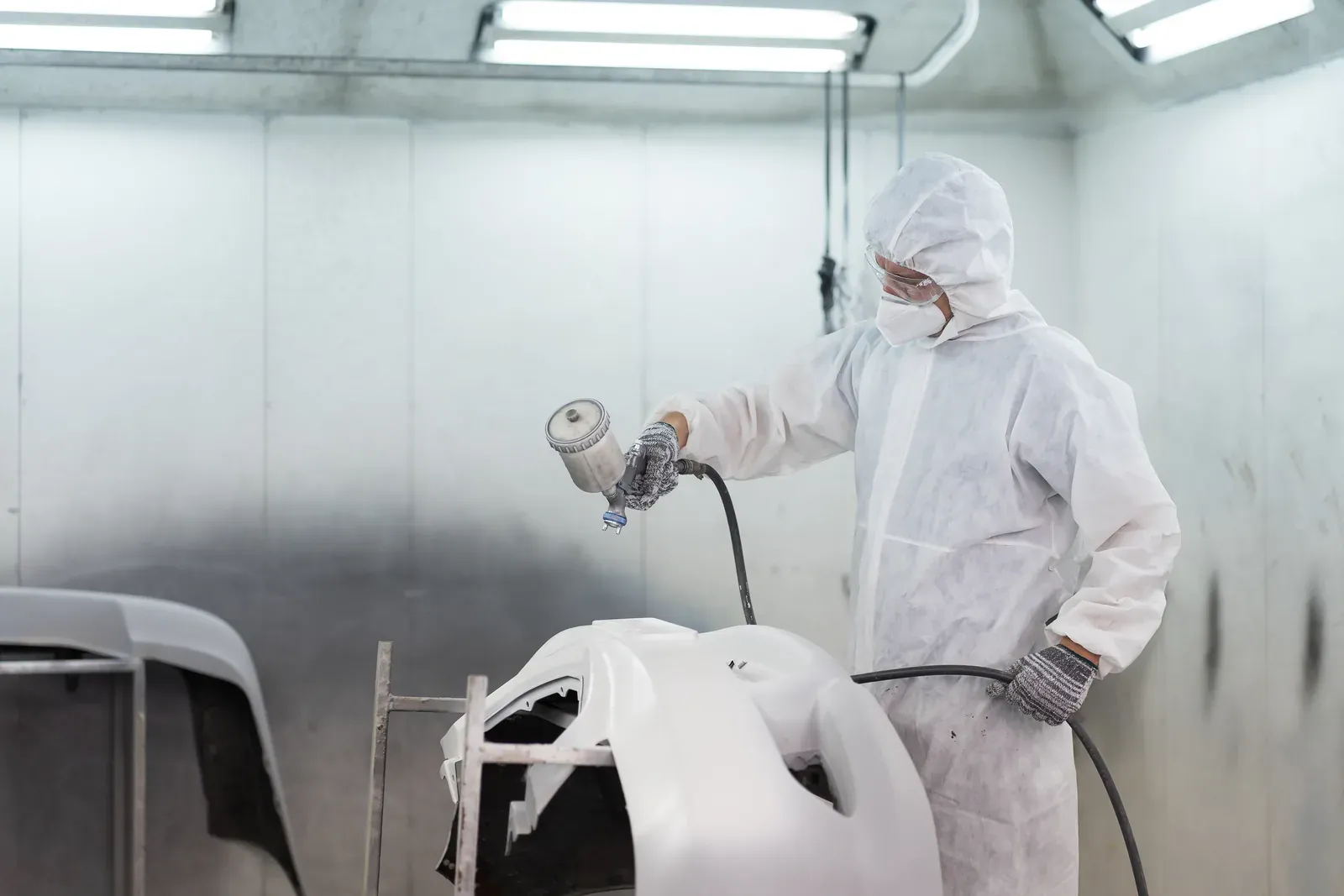
None of these colours is unmatchable — they simply refuse to tolerate shortcuts. The process that beats them runs the same every time: read the colour off your actual panel, let the software surface the candidate variants, spray and compare cards until one disappears against the car, then blend the result into the neighbouring panels so no hard edge is left for the eye to find. The full method lives on our colour matching page, and blending has its own explainer. The compressed version: on the hardest colours, the measurement and the blend aren’t add-ons. They are the match.
Two practical notes if one of these colours sits in your driveway. Expect the estimate to include blend panels — and on a tri-coat, additional material — because that scope is what makes the repair invisible; a pearl-white quote without it deserves suspicion, not gratitude. And when you’re comparing shops, one question sorts them fast: how will you verify the colour before spraying my car? The answer you want describes a card, sprayed and checked against your paint in daylight. The answer you don’t want is a paint brand.