What is panel blending and why is it necessary?
Quick answer
Panel blending means fading fresh colour outward into the undamaged panels beside a repair, then clearing the whole area, so no hard edge exists for your eye to catch. It is necessary because automotive paint ages — a panel sprayed straight from the factory code sits beside sun-faded finish and reads as a patch, even when the formula is technically perfect.
- Drivable or not
- At fault or not
- Free written estimates
Why the factory code is only a starting point
Your car rolled off the line one colour and is a slightly different colour today. Ultraviolet light works on pigments and clear resin year after year, and the drift is too gradual to notice — right up until fresh paint gets parked beside it.
Manufacturing variance stacks on top. The same code sprayed at two plants, or in two production runs, can land measurably apart, which is exactly why manufacturers publish multiple variant formulas for their popular colours.
So a panel mixed straight from the code is matched to a car that no longer exists. We measure the actual paint on your car with a computerized camera, tint the formula toward what the finish is now — and even that is only half the job done.
What blending actually does
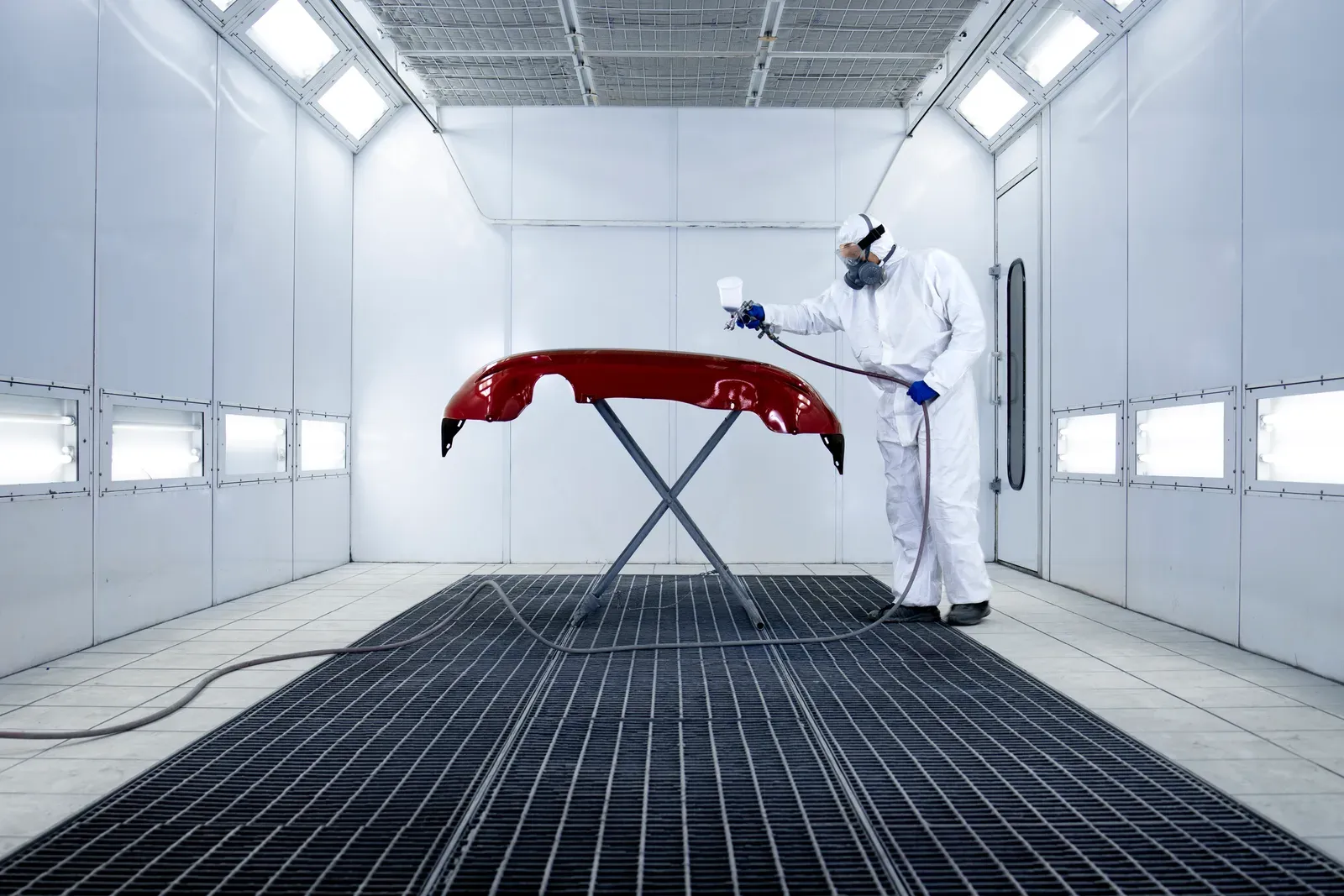
The new colour goes on at full coverage over the repair, then in progressively lighter passes out into the neighbouring panel until it vanishes into the old finish. There is no line where old stops and new starts — the transition stretches across several centimetres and your eye cannot resolve it.
Clear coat then covers the entire area, across the blend and out to a natural break: a body line, a panel edge, the end of the panel. Clear cannot be feathered to nothing in the middle of a flat surface without leaving a visible ridge, so it always runs to a break.
The result is a repair that does not exist as a boundary. Light travels across the fender and door as one continuous surface.
Metallics, pearls, and tri-coats make it mandatory
Solid colours are the forgiving case. Metallic and pearl finishes carry aluminum flake or mica that settles at an angle set by how the paint went on — gun distance, air pressure, pass speed, film build, even the humidity in the booth that day.
Two panels sprayed from one mixed batch on one afternoon can still read differently if the flake lay down differently, which is why silver metallic is the colour that exposes weak paint shops. Blending solves it by letting the flake orientation shift gradually instead of at a hard edge.
Tri-coat whites, pearl reds, and candy colours go a step further: the finish is built from a base, a translucent mid-coat, and clear, so the final appearance depends on how many mid-coat passes were applied. Those get matched by spraying test cards at different pass counts and holding them against the car under colour-corrected light before anything touches the vehicle.
Ranked by how hard they are to match without a blend:
- Tri-coat pearl whites and candy reds — the most demanding finishes on the road
- Silver and light metallics, where flake orientation shows at every angle
- Black and dark metallics, unforgiving of texture and depth differences
- Deep solid reds, which fade fastest and drift furthest with age
- Solid whites and light solids — the most forgiving, and still worth blending
Why blending appears as extra time on the estimate
Blending adds labour and materials on panels that were never damaged, and it is a legitimate, standard operation — not padding. The estimating systems insurance companies use carry specific allowances for it.
What that blend time buys:
- Masking, cleaning, and sanding the adjacent panel so new clear will bond to it
- Extra colour and clear material across a larger area
- Booth time in proportion to the area being sprayed
- A repair that still matches in three years, because the blend ages together with the panels around it
When blending is not enough
Sometimes the surrounding finish is past helping. Heavily oxidized clear, an old repaint that never matched, or peeling on the next panel over means a blend into it only makes the new work look better than everything beside it.
In those cases the honest recommendation is to refinish more of the car — or to accept a known limitation, explained in advance rather than discovered at pickup. Either way, we say it before the job starts.
The roof is the other limit. A large horizontal panel with no break lines often has to be refinished edge to edge rather than blended, because there is nowhere to land a clear coat edge that will not show.
Bumper covers are their own case again. Plastic takes colour a little differently than steel, and a cover meets the light at a different angle than the fenders beside it, so covers are matched and verified against the adjacent panels rather than assumed correct from the formula.
How to judge blend work on a finished car
Look at the car outside, in daylight, from two angles — square on, then low and sharp down the bodyside. A mismatch that hides straight on will jump out at thirty degrees, because that is the angle where metallic flake tells the truth.
Then check texture. The repaired area should carry the same fine factory orange peel as the panel beside it. A glassy, dead-smooth patch next to factory texture is its own kind of mismatch.
Our paint and refinish work is backed by a lifetime warranty, and an invisible match is the standard we hold every job to. That does not happen by luck — it happens by measuring the car, spraying test cards, and blending every single time the colour calls for it.
If you are comparing estimates, read blend lines as a mark of quality rather than a cost to negotiate away. The quote without them is not the cheaper option — it is the incomplete one.