The hits that bend structure happen at Milton speeds
Structural damage needs energy, and Milton’s geography supplies it two ways. The 401 corridor moves at 110 km/h between walls of transport trucks, and when it compresses suddenly — a spill near the 407 interchange, a whiteout squall coming over the escarpment onto the open stretch west of James Snow — the impacts carry enough force to move rails, not just crumple covers. The other source is the countryside: Bell School Line, Appleby Line, and the Campbellville roads reward a moment’s inattention with a ditch, and a front wheel dropping off pavement at rural speed can shove a suspension mount out of position without leaving much visible drama on the body.
The tell-tale signs are worth knowing. Doors that suddenly need a lift or a slam to close. Panel gaps that are wide at the top and tight at the bottom. A steering wheel that sits off-centre on a straight road, or tires wearing unevenly a month after a “minor” collision. Any of these after an impact means the structure should be measured — not eyeballed in a driveway, measured — because a frame that is out by millimetres changes how the car crashes next time, not just how it drives.
Measured before, pulled in steps, measured after
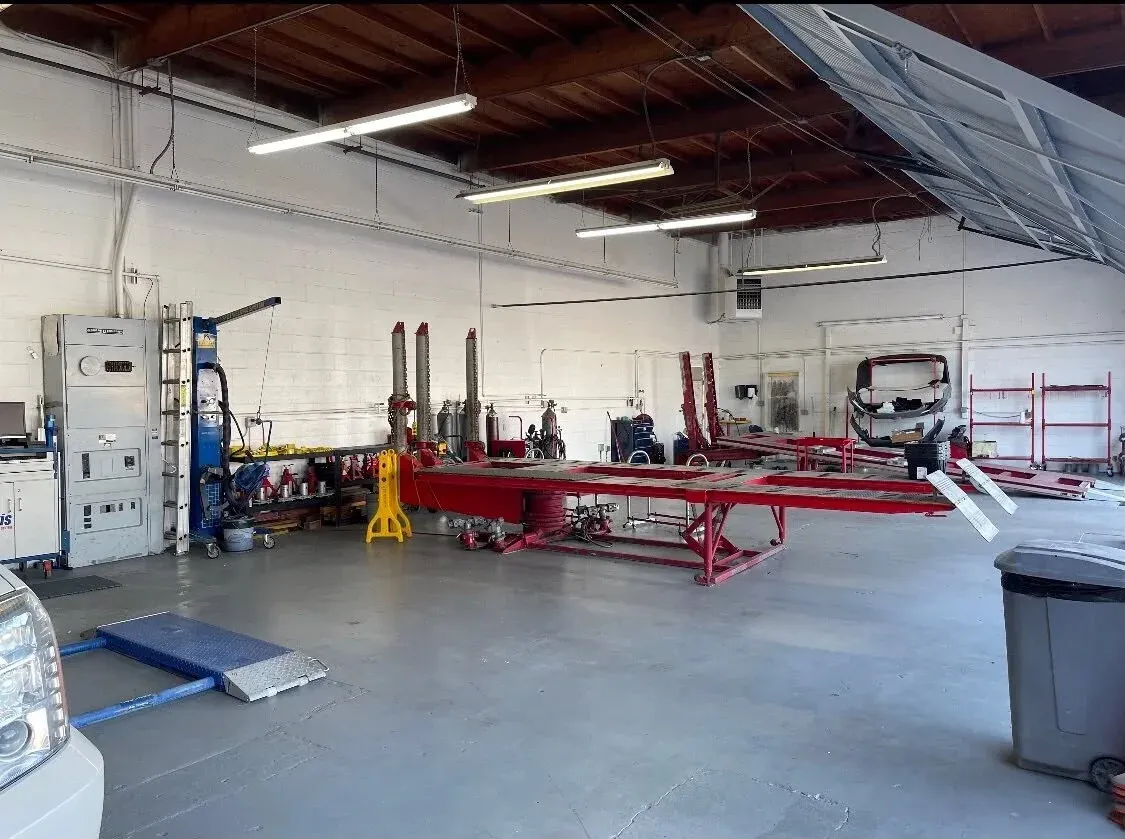
Frame work here is a documentation exercise as much as a mechanical one. The vehicle goes on the bench, laser measurement maps every control point against the manufacturer’s specification, and the printout shows exactly what moved and by how much. The pull happens in controlled steps with re-measurement between them — modern high-strength steels tolerate one careful correction, not repeated guessing — and the final printout proves the geometry is back where the factory put it. That before-and-after record goes into the file your insurance company sees, and it is your proof at resale time that the repair was real.
Structure never travels alone. A hit hard enough to move a rail has usually disturbed suspension geometry, radar or camera aim, and the panels that hang off the damaged section, so the structural file includes alignment and the recalibration of any safety systems the repair touched. Where the damaged section is engineered to be replaced rather than straightened — many modern vehicles specify exactly this for certain rails and aprons — we follow the manufacturer’s repair procedure and push the insurance company for OEM parts, because a millimetre-accurate structure bolted to a not-quite part defeats the point.
- Laser measurement against factory data before any work begins
- Controlled pulls with re-measurement between steps
- Printed before-and-after documentation for the claim and for resale
- Alignment and safety-system recalibration included in the structural file
The total-loss conversation, had early and honestly
Some structural files should not be repaired, and a shop 42 kilometres from your driveway owes you that answer before the car travels, not after. Ontario has no fixed statutory percentage for a write-off — the insurance company weighs the vehicle’s actual cash value against repair cost plus salvage value — so an older car with real frame damage can be a total loss at a repair number that would be routine on a newer one. Send photos and the story of the impact, and the owner will tell you which side of that line the car likely sits on before you spend anything on a tow.
When the car is worth repairing, the distance logistics are ours to manage: the tow east under Ontario’s rules that let you name the destination, the claim opened under DCPD if you were not at fault, the supplement filed with measurement printouts attached, and the rental through your coverage timed to your drop-off. You will get updates from the person running the bench, not a call centre, and the car is inspected and road-tested before you make the 401 run to collect it.