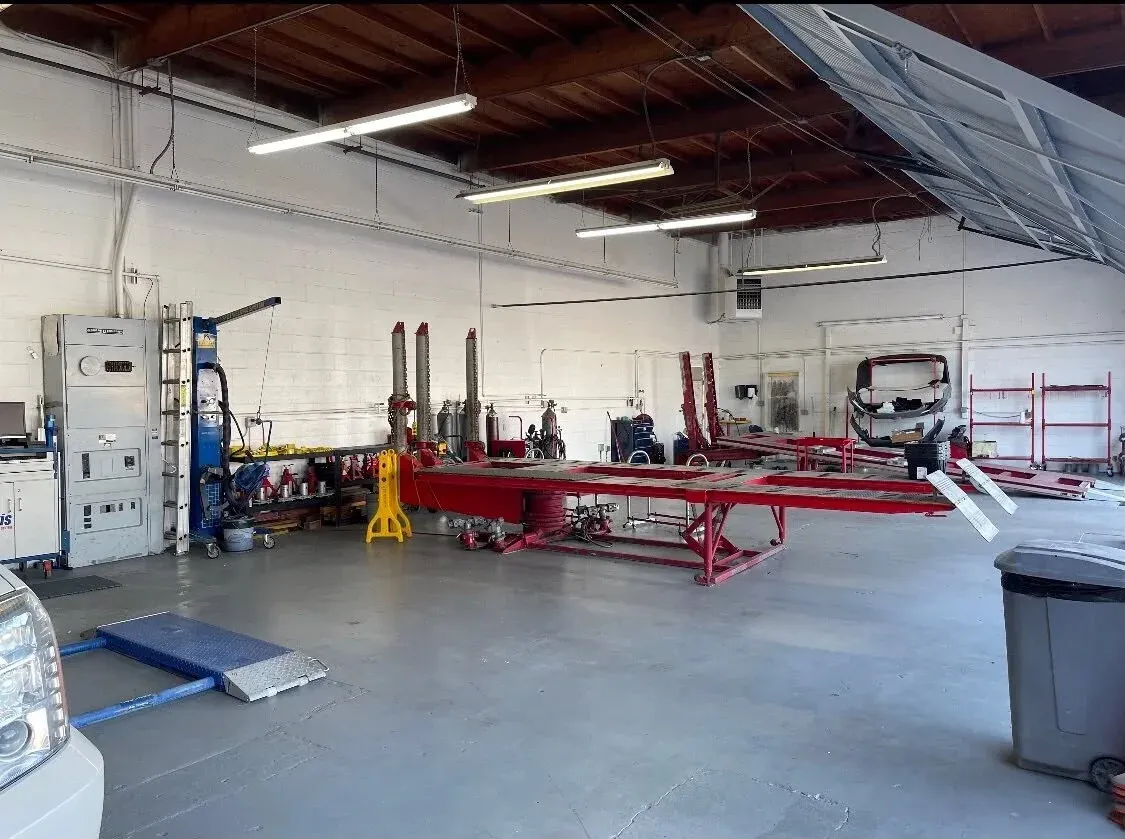
Rural speed is what bends structure
The hits that reach a car’s bones around Georgetown mostly happen where the speed lives. A January slide off 15 Side Road or one of the lines toward Terra Cotta ends in a ditch or against a culvert entrance, and the impact loads one front corner — exactly the geometry that pushes a rail back and out of specification. A deer strike at dusk on Trafalgar north of town concentrates force into the radiator support and upper rails. And the 401 supplies the rest: a chain rear-end in the Milton stop-and-go can shorten a rear body enough to matter while the bumper cover, absurdly, still looks presentable.
What makes structural damage dangerous is that it hides behind drivable. A car can track almost straight with a rail 8 mm out of place. The tells show up later — doors that catch, a steering wheel slightly off-centre, tyres wearing unevenly, gaps that changed width along one fender. If your car has been through any of those hits and shows any of those signs, it needs measuring, not guessing.
Measured, pulled, measured again
Straightening is a documentation exercise as much as a mechanical one. The vehicle goes on the bench and is measured against the manufacturer’s reference dimensions, so the conversation starts with numbers: which points moved, in which direction, by how many millimetres. The pull happens in controlled stages — anchor, load, release, re-measure — because metal that was forced somewhere must be walked back, not yanked. When the points read within specification, we record the after-measurements so your file shows the structure was verified, not eyeballed.
Modern unibodies complicate this in ways worth knowing. High-strength steels in specific zones are designed to crumple once and be replaced, not straightened — pulling them can weaken the crash structure your family relies on next time. Where the factory procedure says section and replace, we follow it and we push your insurance company for OEM structural parts, because a safety-critical rail is the wrong place for a like-kind-and-quality experiment. That argument is ours to make, and we make it with the measurement printout in hand.
- Baseline measurement against factory reference dimensions
- Staged pulls with re-measurement after every step
- Replacement — not straightening — where factory procedure requires it
- OEM structural parts argued for with your insurance company
When the honest answer is “don’t repair it”
Structural files are where repair costs climb fastest, so this is also where total loss becomes a live question. Ontario has no fixed statutory percentage: your insurance company weighs the repair cost plus salvage value against the vehicle’s actual cash value and makes a business decision. Our job is to get you a real number early — teardown and measurement first, so the estimate reflects the true scope — and to tell you plainly when a car is worth fighting for and when the smarter move is settling and moving on. A shop that always says “repairable” is selling, not advising.
The logistics from Georgetown are built around one truth: a structurally damaged car should not be making a 42-kilometre highway run. It comes down on a flatbed — Ontario’s towing rules put the destination in your hands, so name Collision Auto Center, North York, off Keele just south of Sheppard — and the claim, the measuring, the supplement, and the rental through your coverage all run from our office while you stay in Halton Hills. Call (647) 594-3401; Monday to Saturday, 8 AM to 7 PM, Sundays by appointment.