What is a clear coat and why does it fail?
Quick answer
Clear coat is the unpigmented top layer of a modern two-stage finish. It carries the gloss and — more importantly — the ultraviolet absorbers that shield the colour beneath. It fails from the top down when years of sunlight exhaust those absorbers and start breaking the resin itself; washing does not wear it away. Once it delaminates, refinishing is the only real fix.
- Drivable or not
- At fault or not
- Free written estimates
What is actually on your car
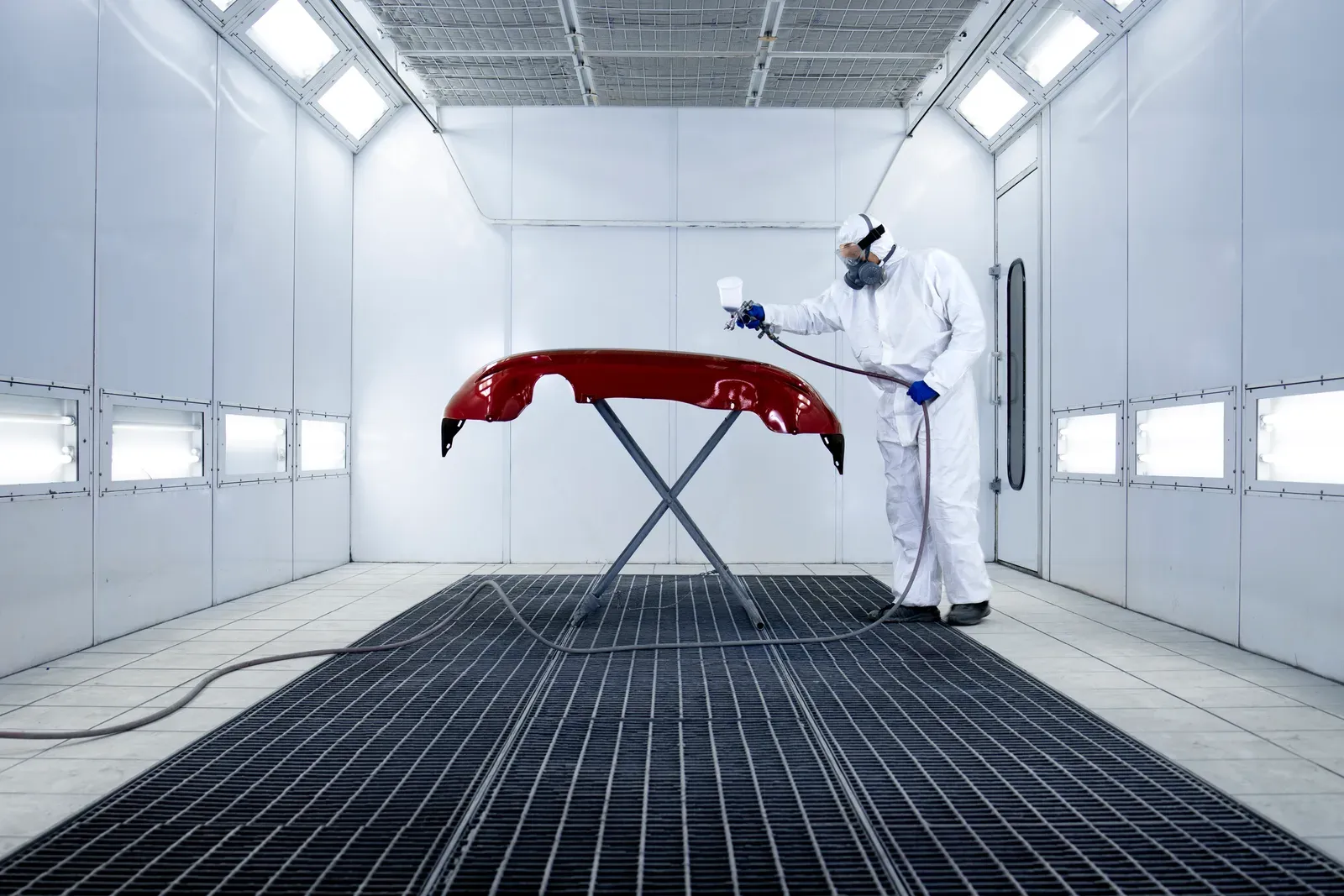
A factory finish is built up in layers over bare metal. Electrocoat primer goes on first for corrosion protection, then primer surfacer, then the base coat carrying all of the colour and flake, then clear coat over everything.
The base coat is thin, matte, and nearly defenceless on its own — essentially pigment suspended in a binder. Everything you experience as your paint job, the depth and the shine and the wet look, is the clear layer above it.
That clear is a two-component urethane that crosslinks chemically as it cures into a hard, glossy film. Mixed through it are ultraviolet absorbers — sacrificial molecules whose entire job is to intercept UV energy and shed it as heat before it reaches the resin or the pigment underneath.
From the metal outward, the stack reads:
- Bare steel or aluminum panel
- Electrocoat primer, dipped at the factory for corrosion protection
- Primer surfacer, filling and levelling the surface
- Base coat, carrying all of the colour, flake, and pearl
- Clear coat, carrying the gloss, the durability, and the UV absorbers
How it actually fails
Clear coat does not wear off. Rain, washing, and driving do not abrade it away. It fails photochemically, from the top surface downward.
Season after season of sun consumes the UV absorbers. Once they are spent, UV energy starts snapping the polymer chains in the resin itself. Gloss goes first, then a chalky, milky haze develops, then a web of cracks too fine to see one at a time.
Water and contamination work into those cracks and reach the boundary between clear and base. Adhesion at that interface lets go, and the clear begins lifting in sheets — which is why failed clear looks like peeling sunburn rather than a worn surface. Once an edge exists, it keeps lifting. It never stops on its own.
The progression is consistent enough to diagnose by: gloss loss, then chalky haze, then fine cracking, then a lifted edge, then sheets. Anywhere before the lifted edge, you are still looking at a one-panel job.
Why it always starts on the horizontal panels
Roofs, hoods, and trunk lids fail first and worst, every single time, because they face straight up. They collect far more direct UV per year than any vertical door, and they run the hottest — which accelerates every chemical reaction involved.
Other factors pile on top of the exposure:
- Bird droppings and tree sap, acidic enough to etch the film when left to bake
- Heat cycling — a GTA panel can swing from -25 °C in January to over 60 °C under July sun
- Aggressive or repeated buffing, which physically thins the clear film
- Thin factory clear over aluminum hoods and plastic panels, which started with less film
- Old bargain repaints with no UV package in the clear, or clear over poorly prepped base
- Roof racks, cargo boxes, and vinyl graphics that trapped grit and moisture against the surface
Why no product restores failed clear coat
Everything sold as a "clear coat restorer" is a polish or a glaze. It removes a little oxidized material and fills micro-scratches with oils, which genuinely revives a dull-but-intact finish for a while.
That trick works while the film still exists. It cannot work once the clear has cracked or let go of the base, because there is nothing left to polish — the layer has failed structurally. Polishing a failing film just removes more of what remains and hurries the ending.
The only true repair is refinishing: sand off the failed clear, take the panel to a sound layer or to primer, seal it, and spray fresh base and clear out to a natural break line — because a clear edge in the middle of a flat panel will always show.
Spraying new clear over a failing film does not work either, tempting as the shortcut is. The new layer bonds to a base that is already releasing, so the repair delaminates along with everything under it — usually within a season or two.
Catching it early is much cheaper
Failing clear announces itself before it peels. Watch for a patch on the roof or hood that has lost its reflection and gone faintly milky, especially next to a still-glossy vertical panel. At that stage, one refinished panel solves it.
Ignore it and the peeling walks across the panel, then onto the next one, until you are pricing the whole top half of the car. It also exposes the base coat — which has no UV defence at all and fades fast — and then bare primer, which is porous and passes moisture straight to the metal.
Prevention is genuinely simple: wash regularly so contamination cannot sit and etch, keep a wax, sealant, or ceramic coating on as a sacrificial UV layer, and choose shade or a garage when there is a choice. None of it undoes existing damage; all of it buys years.
Where failed clear most often meets our work is on an accident or hail claim: hail that cracked the film is comprehensive-claim damage in its own right, and aging clear on the panels beside a collision repair limits what blending can do — which is why we flag it on the estimate before work starts, match the colour to the car as it stands today, and back the refinish with a lifetime warranty.
One caution specific to this climate: a panel that loses its clear heading into an Ontario winter enters salt season with its armour off. Base coat passes moisture, primer drinks it, and by spring the refinish you postponed has corrosion work stapled to it. If the haze is visible in October, October is the month to deal with it.