Dents are the tax on parking outside
Most of Long Branch parks in the open. The lots south of Lake Shore were drawn for summer cottages, and the bungalows that followed kept the dimensions — short driveways, mutual drives shared with the neighbour, and the curb for whoever got home last. A mutual drive leaves centimetres on either side of the mirrors, and every winter it claims fenders when someone threads it in the dark. Street-parked cars collect the rest: doors swung open into them, cyclists’ handlebars, and the slow-motion sideswipe from a van that misjudged a street narrowed by snowbanks.
Two other local factories keep us busy. The commuter lot at Long Branch GO packs cars door-to-door from the first train to the last, and the dings accumulate one careless push at a time. And the neighbourhood’s constant infill construction fills the numbered streets with contractor pickups, dumpsters, and material drops — tailgates meet fences, side panels meet scaffolding, and parked cars near a build site take shrapnel nobody stays to confess to.
How a dent actually gets repaired
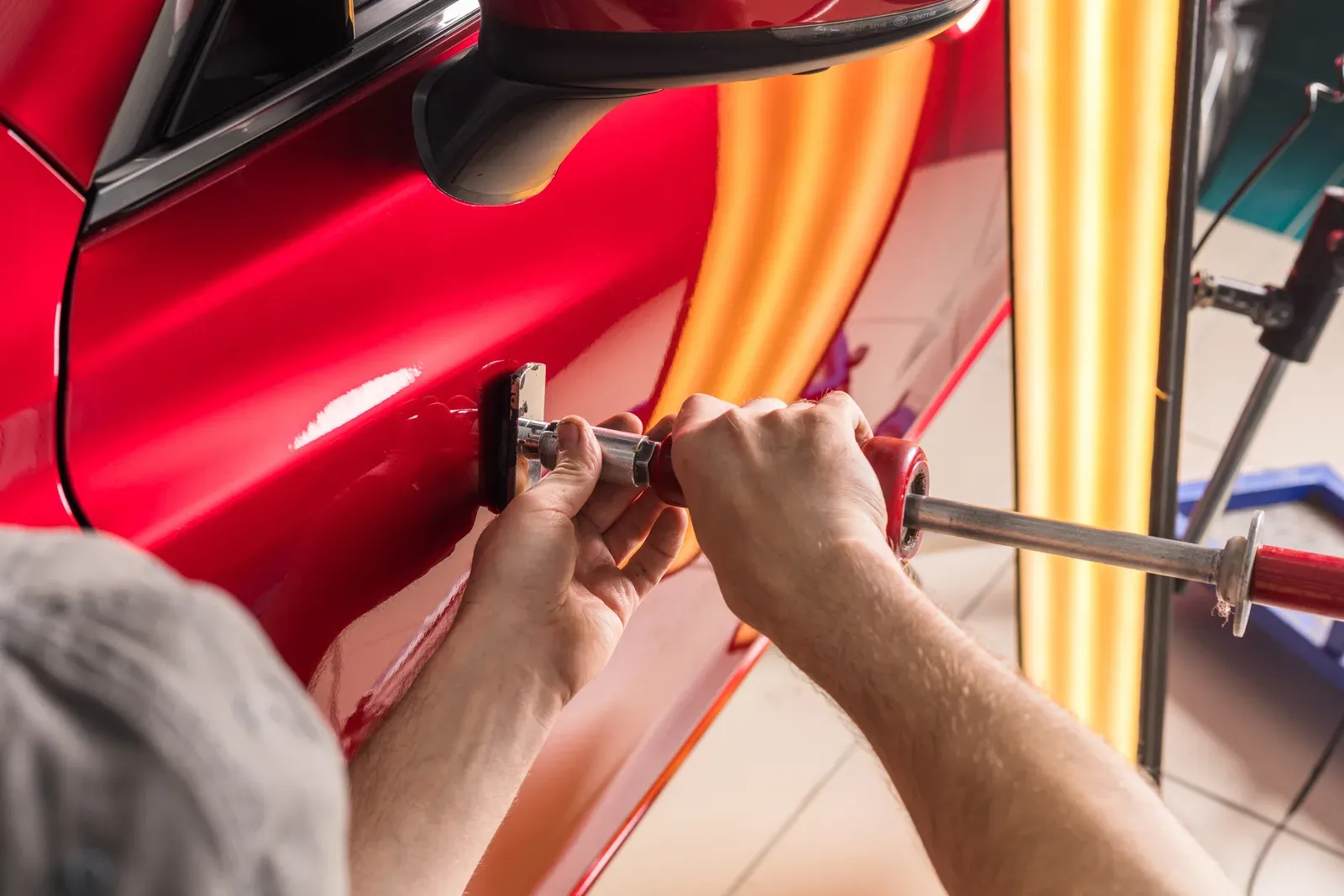
The first question is not size — it is depth, paint condition, and access. A shallow dent with unbroken paint on a reachable panel can often be worked back out from behind, preserving the factory finish so nothing needs respraying. Once the metal is stretched or the paint has cracked at the bottom of the dent, working it out is no longer enough: the panel gets straightened, filled where the metal demands it, and refinished with a colour match blended into the panels around it. A hard crease through a styling line on thin modern steel is sometimes cheaper and better to replace than to rebuild, and we will tell you when that is true.
Aluminum changes the playbook — a growing number of hoods and tailgates are aluminum, which dents differently and cannot be worked like steel — so we identify the panel material before promising a method. Whatever route the repair takes, refinished panels carry our lifetime paint warranty, and replaced panels carry the parts-and-installation warranty. The goal is the same in every case: a panel you cannot pick out of the car six months later.
Claim it, or pay for it yourself?
For small dents this is the real question, and the arithmetic is simple: if the repair costs less than or close to your deductible, a claim gains you nothing. When another identified driver caused the damage — they backed into you and stayed, or a note ended up on your windshield — DCPD means your own insurance company pays and no deductible may apply, which changes the math completely. An anonymous ding in the GO lot, with nobody identified, generally lands on your own collision coverage and its full deductible.
So we price it both ways. Send photos and the written estimate shows the cash number plainly, and you decide with real figures instead of guesses. One-panel jobs are scheduled tight so the car comes up the 427 once and comes home fast — usually in a day or two for a repair-and-refinish, same day when no paint is involved. Hours are Monday to Saturday, 8 AM to 7 PM, Sundays by appointment; the shop is off Keele just south of Sheppard.