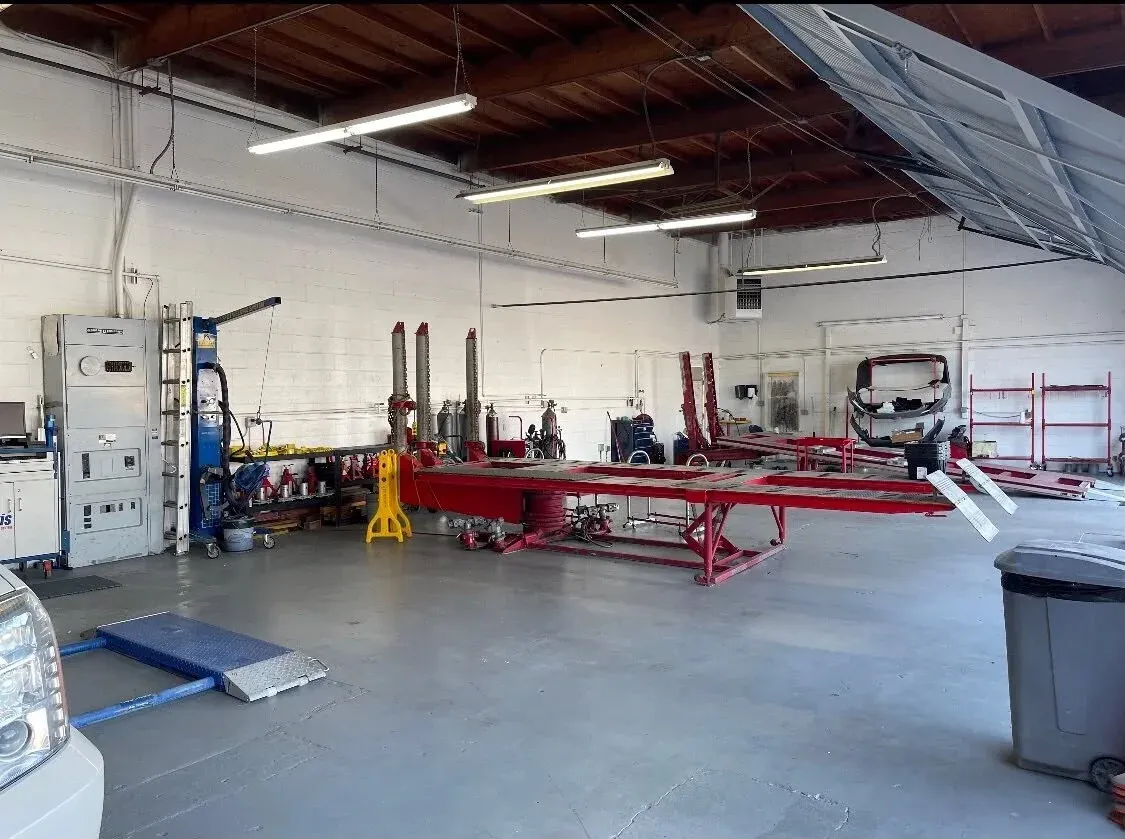
Which Malton hits reach the structure
Structural damage needs energy, and Malton’s roads supply it. A misjudged left off Airport Rd at Derry or Morning Star puts two vehicles together at genuine speed, and the loads travel past the bumper into the rails and aprons that carry the front of the car. The 427 and 401 ramps produce the same physics at a shallower angle — a merge sideswipe that shoves a car across a lane loads the suspension sideways, and the force ends up in the mounting points. And a tractor-trailer contact on Derry is its own category: the mass difference means even a slow shove from a truck can move metal a car-to-car hit would not.
The deceptive cases are the ones with no other vehicle at all. The freeze–thaw craters that open on Goreway and Morning Star each spring hit hard enough at 60 km/h to bend more than a rim — control arms, subframe mounts, and steering geometry can all shift while the body panels stay flawless. If the car pulls, wanders, wears a tire strangely, or the steering wheel sits off-centre after a hard pothole strike, that is a measurement question, not an alignment guess.
Measured, pulled, measured again
Modern cars are unibody — the “frame” is dozens of stamped panels welded into one structure, engineered to crumple in exact places so the cabin does not. Repairing it is therefore a numbers exercise. The car goes on the bench, reference points are measured against the factory dimension data, and the readout tells us precisely which points sit out of position and by how many millimetres. Nobody sights down a rail and declares it close enough.
The pull itself happens in small, controlled steps, re-measured as it goes, because metal that is dragged back in one heave is metal that has been stressed twice. Where the engineering calls for it, sections are replaced rather than straightened — crush zones that have done their job once are done, and we push for OEM structural parts wherever the repair touches crash performance. The before-and-after measurements are documented and yours to keep, which matters for the insurance file today and for any buyer’s questions years from now.
- Electronic measurement against factory dimension data
- Controlled pulls, re-measured at every step
- Sections replaced when straightening would compromise them
- Documentation of final measurements included with the repair
The frame question and the total-loss question
Structural damage is where repair costs climb fastest, so it is also where the total-loss conversation starts. Ontario has no fixed statutory percentage: your insurance company weighs the car’s actual cash value against repair cost plus salvage value and decides case by case. Our job is to make that decision honest — a real teardown and a measured damage map instead of a parking-lot guess, so a repairable car is not written off lazily and an unrepairable one is not strung along at your expense.
For a Malton household whose vehicle is also its income, we add the practical layer: what the repair timeline looks like with structural parts on order, what the rental coverage will bear, and whether a tow is needed rather than a drive — a car with a moved rail should come in on a flatbed, and Ontario’s rules let you direct that tow to us from wherever the car sits. Call (647) 594-3401 before anyone moves the vehicle and we will coordinate the rest.