Two kinds of parking, two kinds of dents
The Stockyards District is the Junction’s dent factory. Its lots serve some of the highest-volume retail west of downtown, and high-volume lots produce the full catalogue: swung doors from the next stall, reversing taps between rows, curb stops that catch a bumper corner just deep enough to crease the quarter behind it, and the strikes whose authors are gone before you are back with the groceries. Nobody reports most of it. The dent is simply there when you come back with the groceries, and the decision about what to do next is yours alone.
South of St. Clair, the damage changes character. The residential streets off Annette, High Park Ave, and Quebec Ave park cars along both curbs of a grid drawn narrow, so passing mirrors and misjudged gaps write their signatures on parked doors. The laneways behind the Victorian rows are tighter still — a half-turn taken lazily puts a long, shallow crease down a rear quarter. And every January, windrows harden along the curb lines and shrink the margins again, so backing out over frozen snow ridges folds sheet metal at speeds barely above walking pace.
Repair the metal or replace the skin — how we decide
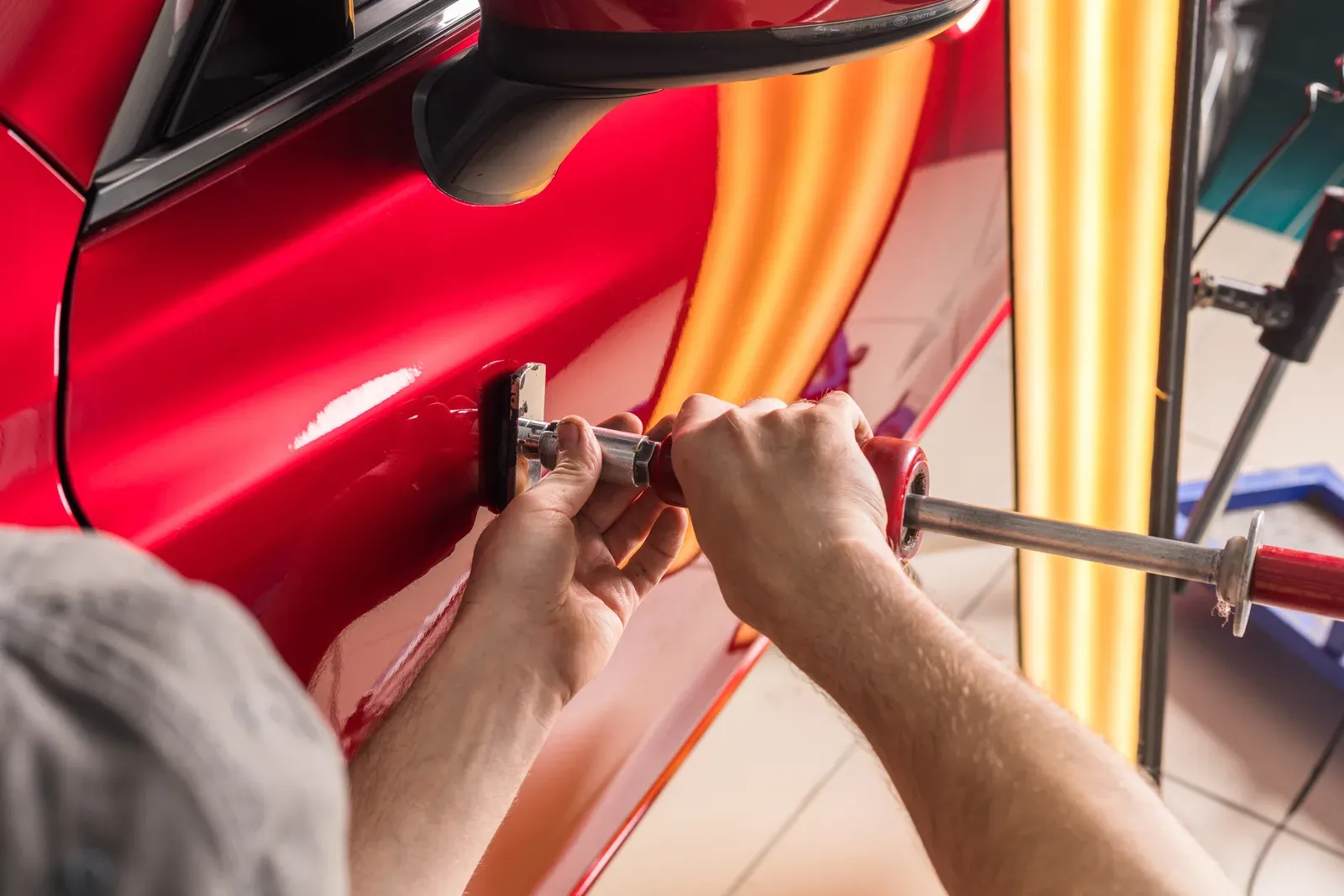
A dent is judged on depth, sharpness, and where it sits. Broad and shallow in the middle of a door: the metal usually works back to shape cleanly. A sharp crease across a bodyline, or damage at a panel edge where the steel is stiffest, often means the metal has stretched past honest recovery — and forcing a stretched panel back costs more than a new skin while looking worse. We make that call in front of you, and when a dent genuinely sits on the fence, we price both routes so the choice is yours with real numbers attached.
Paint decides the second half of the job. Where the finish cracked or scraped through, refinishing is part of the repair — colour matched to your code, adjusted for the way your car has weathered, blended into the neighbouring panels, and covered by the lifetime warranty. Where the paint held, we say so, because intact paint makes the job smaller — and whether an insurance company or your deductible is paying, you should hear that from the shop rather than discover it after overpaying somewhere else.
- Depth, sharpness, and location decide the repair route
- Fence-sitting dents priced both ways, your choice
- Broken paint refinished and blended under a lifetime warranty
- Intact paint acknowledged — a smaller job, honestly priced
Most Junction dents never need a claim — and we will tell you which
A single door ding from a Stockyards lot usually prices near or below a typical deductible, and in that territory a claim buys you nothing. We are direct about it: photos to (647) 594-3401, a written number back, and a plain recommendation — absorb it, or claim it. When another identified driver caused the dent and left their information, DCPD generally applies and the repair runs through your own insurance company, often without a deductible depending on how your policy is set up; we help you confirm how your situation is positioned before you commit either way.
Booking is built around Junction schedules. The run up Keele takes 14 to 22 minutes; drop-offs fit any time between 8 AM and 7 PM Monday through Saturday, with Sundays by appointment; and a one-panel dent with refinishing is typically a few days of work, most of it cure time. Dents that never broke the paint can move faster. Either way, the car comes back down Keele with the panel reading like nothing ever happened.