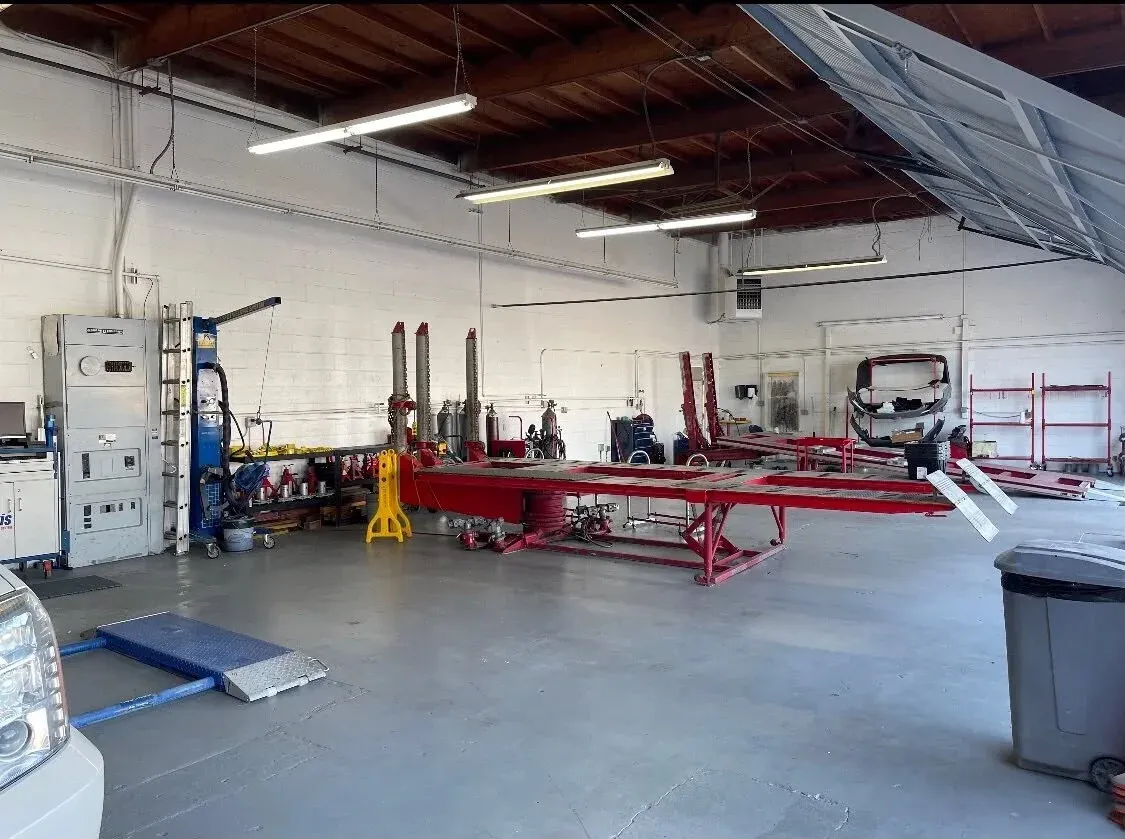
You do not need a highway to bend a unibody — but this area has two
The hard hits from Bayview Village come off its edges. The 401 at Bayview and the 404’s first kilometres carry commuter volume that stops without warning, and a rear-end at those speeds drives energy into rails and trunk floors that were engineered to fold — and did. The gentler-looking version happens inside the neighbourhood: black ice on a curving street, a curb taken hard at the apex, a wheel shoved rearward with the control arm and the rail end following. Both cars might drive afterward. Neither should be assumed straight.
On a unibody car — which is nearly every car in these driveways — the body shell is the structure. A strut tower or apron sitting a few millimetres out of position does not announce itself; it whispers. The steering wheel that will not centre after an alignment. Hood gaps that taper. A door that needs a firmer pull than it used to. Tires feathering on one edge. Any of those after an impact is a reason to measure, because millimetres are the difference between crash structure that folds as designed next time and structure that does not.
The bench does not have opinions — that is the point
Structural repair here is run by measurement, start to finish. The vehicle is fixtured on the bench, its reference points are read against the factory’s published dimensions, and the printout says which points moved and by how much — no squinting, no judgment calls about “close enough.” Pulls are applied in increments: load, release, re-measure. Metal hauled past its target in one dramatic pull has been damaged twice, so the discipline is patience. When every point reads within specification, the before-and-after documentation is printed for your records and your insurance company’s file.
Structural work is also where the parts argument matters most. If a rail section or reinforcement is being replaced, we push the insurance company for OEM — crash structure is the wrong place for approximately-equivalent, and we say so to adjusters in exactly those terms. Suspension geometry disturbed by the same impact is aligned after the structure is true, and the car is road-tested before anyone calls you to collect it.
- Reference points measured against published factory dimensions
- Controlled incremental pulls, re-measured at every stage
- Printed before-and-after documentation for the claim and your records
- Alignment and road test after the structure reads true
When to tow, and when to talk about writing it off
Some cars should not attempt even the nine easy kilometres of Sheppard. If a wheel sits visibly wrong, the steering pulls hard, a door will not latch, or anything is dripping, park it and call (647) 594-3401 — we coordinate the tow from wherever it stopped, and Ontario’s towing rules put the destination in your hands. Say the shop’s name to the operator; the alternative is a storage yard with a daily rate and no interest in your schedule.
The other early conversation is the honest one. Ontario sets no fixed percentage for a write-off — the insurance company weighs the car’s actual cash value against repair cost plus salvage, case by case — and structural estimates are big enough to bring some cars near that line. We would rather show you the math in week one than have you discover it in week four. When repair wins, the car is pulled to specification, documented, and warranted. When it does not, you hear it from us plainly, with your next steps laid out.